Cultivating a Digital Garden: Don't Let Great Ideas Disappear into the Social Feed
Social media feeds are fast-flowing streams that forget everything in 24 hours. Why serious creators need a digital garden where published thoughts compound over decades.
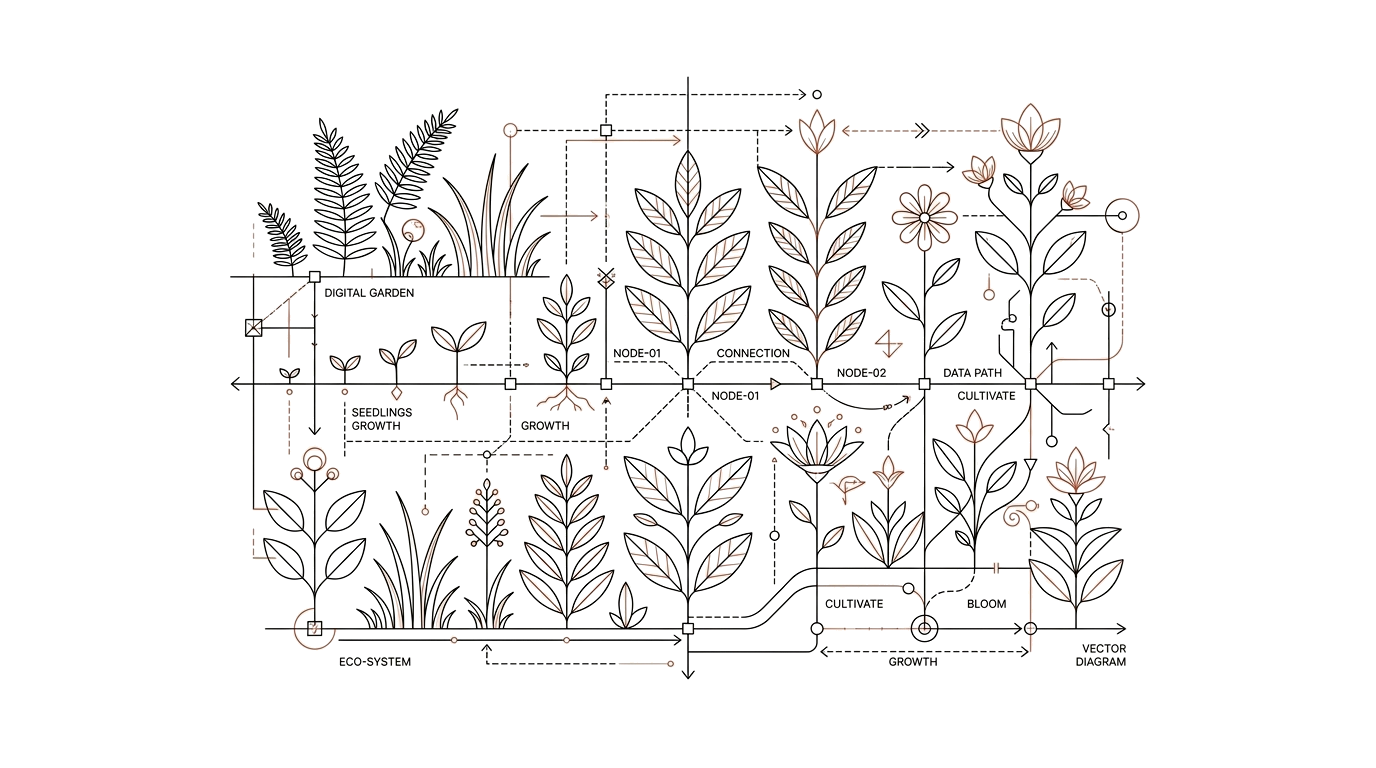
If you have been sharing your thoughts publicly on social platforms for any length of time, you have likely felt this quiet absurdity:
A few months ago, late at night, a stroke of clarity hit you. You wrote a concise, sharp observation about how your industry was shifting. That post received hundreds of likes and reposts. Notifications buzzed relentlessly. You went to sleep riding an intoxicating dopamine high.
Yet forty-eight hours later, the post had sunk beneath the surface like a pebble dropped into a deep pond. The ripples vanished completely. Six months later, when you sat down to write an essay on that exact subject and urgently needed to quote your own reasoning, you spent twenty minutes scrolling through your profile and still couldn't locate it.
You end up feeling like a child building elaborate sandcastles on the beach: twice a day, the high tide rolls in and washes away yesterday's creation. To prove you still exist, you have to sprint back at low tide to build another castle destined to vanish.
When a creator's entire output is organized strictly chronologically—condemned to be buried under tomorrow's newsfeed—the long-term creative pursuit inevitably turns into intellectual exhaustion.
The Roaring Stream vs. The Quiet Garden
The digital theorist Mike Caulfield introduced an enduring metaphor that clarifies how information behaves online: the dichotomy between The Stream and The Garden.
The Stream                     The Garden
------------------------       ------------------------
Chronological (Time-ordered)   Topological (Context-linked)
Ephemeral (Dies in 24 hours)   Evergreen (Compounds over decades)
Reactionary & Emotional        Reflective & Interconnected
Feeding the Algorithm Cultivating Knowledge Assets- The Stream (epitomized by X, Threads, and LinkedIn): A roaring, torrential river. Everything flows past at breakneck speed. It is optimized exclusively for the present moment, constantly demanding that you react to whatever happened in the last twenty minutes;
- The Garden (epitomized by personal wikis, thematic vaults, and evergreen essays): A plot of rich, fertile ground. You plant seeds, prune branches, clear walking paths, and let things mature. Ten years later, an early seed hasn't rotted away—it has grown into a sturdy tree whose roots nourish new ideas.
Creators who live entirely within The Stream eventually suffer creative bankruptcy. You expend all your mental bandwidth feeding the algorithmic beast, only to realize you possess almost zero durable assets to show for your labor.
Don't Boycott the Stream—Build a Bridge to It
This does not mean writers should retreat into hermit-like offline text documents and renounce public discourse.
On the contrary, the stream is the premier testing ground for raw thoughts. A single concise tweet can reveal with zero ceremony whether a conceptual spark resonates with your peers. Reader pushback, unexpected questions, and real-time counterarguments expose blind spots in our logic before we invest weeks into a full-length piece.
Experienced creators do not frame this as an all-or-nothing choice. Instead, they build a deliberate feedback loop between the stream and the garden:
- Catch sparks in the stream: Float raw intuitions in short posts and note where genuine friction or resonance occurs;
- Irrigate the garden with those insights: Bring validated ideas back into your workspace. Give them tags, link them to relevant themes, and let them quietly mature into comprehensive arguments;
- Harvest ripe fruit back into the stream: When an essay in your garden reaches full maturity, condense its core takeaways into a crafted thread or visual insight and send it back out to the world.
The stream is the roadside market where you share the fruit. The garden is the orchard where life actually happens.
How MuseCanto Cultivates Your Creative Garden
Most creative tools enforce a frustrating divide: note apps like Obsidian or Notion serve as your garden, but they are completely disconnected from your distribution channels; social scheduling utilities let you queue tweets, but behind their text box lies an empty void.
MuseCanto was designed from the ground up to unify deep accumulation with public expression:
1. Hierarchical Knowledge Vaults (Books & Topics)
In MuseCanto, your thoughts are not isolated markdown files scattered across folders. You organize your work into living Books and Topics. Whether you are drafting a multi-chapter engineering guide, archiving investment theses, or tracking an emerging market trend, every document has a clear home and spatial relationship to your other work.
2. Zero-Friction Branching from Garden to Stream
When an insight in your document crystallizes, you don't need to copy and paste it into an external social buffer. With a single click in the side panel, you can generate a social thread draft directly alongside the source document. The connection remains intact forever—you always know which essay spawned which thread.
3. A Compounding, Searchable Archive
Every article you refine and every thread you dispatch remains permanently indexed within your workspace. Three years from now, when you decide to publish a physical book or design an online masterclass, you won't start with a blank page. You will walk into an established garden containing hundreds of interconnected, pre-validated essays ready to be assembled.
The Best Time to Plant a Tree
Algorithms shift quarterly. Social platforms rise, transform, and fade. The viral distribution hack that worked last summer will be obsolete by next winter.
The intellectual framework you cultivate, the body of original work you systematically record, and the thoughtful readership you earn through depth—those are assets no algorithm can confiscate.
Stop letting your best thoughts disappear into the river of yesterday's updates.
Start planting seeds in your own garden today.